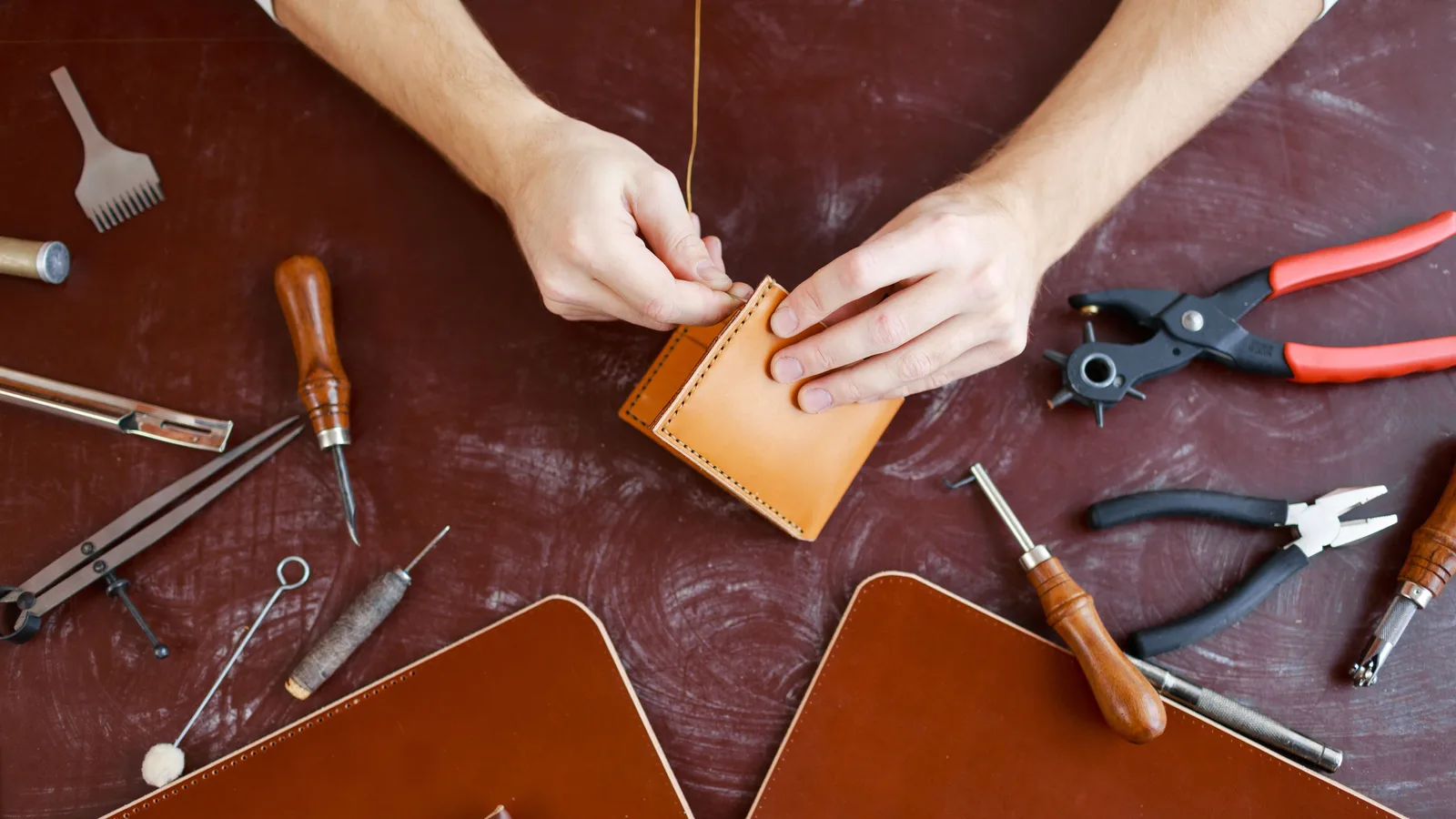
How to tell if leather is real: 6 quick tests that work
Six quick checks — grain, smell, the press test, a drop of water, the edges and the label — that reveal whether leather is real hide or plastic.
The short answer
Real leather is animal hide that has been tanned and finished. Faux leather — often sold as PU, polyurethane, PVC or vegan leather — is a fabric or plastic base with a coating sprayed or bonded on top. The two can look almost identical in a photograph and fairly similar on a shop shelf.
No single test settles it on its own, but three together almost always do. The quickest signals are smell and how the surface behaves under your thumb. The most reliable is the reverse side and the cut edges, because a coating can imitate a grain but rarely imitates the fibrous back of a hide.
Work from the checks that do no harm to the item first, and stop as soon as two of them agree.
What you need before you start
- Good light
- Daylight by a window. A phone torch held at a low angle rakes across the surface and makes grain and coating far easier to see.
- A magnifier
- A magnifying glass, a jeweller's loupe, or simply your phone camera zoomed in and held steady.
- One drop of water
- Cool tap water. A single drop on a hidden patch, blotted straight afterwards.
- A soft cloth
- A clean cotton cloth or tissue to blot the water — never rub it in.
- The label or listing text
- Photograph the care label and the online description. The wording often settles the question faster than any physical test.
- Permission
- Only test goods you own or are seriously considering buying. Never press, drop water on or lift a flame to stock in a shop.
Set the item down flat in good light and take the label photo first, so you have a record if you walk away to think about it. Do the smell and press checks before anything involving water, and leave the water drop until last — it is the only one that carries a small risk of marking the finish.
Six checks, in the order to do them
1. Smell it
Real hide smells warm and faintly animal — of tanning, of a saddlery, of something that was once a skin. Faux leather smells of plastic, glue or a sharp chemical note. Be careful here: new faux is sometimes treated with a leather-type fragrance, so a strongly perfumed smell is a reason to be suspicious rather than a reason to relax. Smell close to a seam, where the coating edge is exposed and the smell is least disguised.
2. Look at the grain in raking light
Tilt the item towards the light and study the surface. Real grain is irregular: pores differ in size, fine lines wander, and no two panels repeat the same pattern. You may find small scars, veins or a change in texture across the hide. Faux tends to be unnaturally even, with a pattern that repeats exactly across two panels or a rubbery, flat look. Coated leather sits somewhere in between — it is real hide under a pigment layer, so the grain may look too tidy.
3. Press it with your thumb
Press firmly for two or three seconds and watch what happens. Real leather wrinkles into fine lines that radiate outwards from your thumb and then fades back. Faux tends to stay smooth, or creases in one hard line, and can feel cold and slightly tacky against the skin. Very dry or heavily coated leather may crease and recover slowly, so treat this as one signal rather than a verdict.
4. Put one drop of water on a hidden patch
On an untreated or lightly finished leather, a drop sits for a moment, then darkens the surface as it is drawn in. On a plastic coating or faux leather it beads on top and sits there. The catch is that most finished bags, shoes and jackets are coated, so water can bead on genuine leather too. Blot the drop immediately with the cloth and do not rub. If the patch darkens, leave it to dry naturally, away from heat.
5. Turn it over and inspect the edges
The reverse of a real hide is fibrous and suede-like, often a slightly different colour from the face. Faux shows a woven fabric backing — you may see the weave at a seam — or a uniform plastic core at a cut edge. Look at a strap end or the inside of a buckle loop: good leather goods are burnished, folded or painted at the edge, but underneath that you should still find fibres, not a sandwich of plastic and cloth.
6. Read the wording on the label
Labels and listings are written by people who know exactly what they are selling. Words that point to hide: full-grain, top-grain, cowhide, lambskin, calfskin, goatskin, '100% leather'. Words that point away from it: PU, polyurethane, PVC, vinyl, 'vegan leather', 'leather blend', 'leatherette', 'faux'. And 'genuine leather' on its own is a low bar — it is a description, not a grade, and it is used on bonded and corrected-grain material as freely as on good hide.
What the label terms actually mean
The same word can cover very different materials — this is what each term is really describing.
Term
What it is
- Full-grain
- The whole hide with the grain left intact and barely sanded.
- Top-grain
- The upper layer of the hide, lightly sanded and usually pigmented.
- Corrected-grain
- The surface sanded flat and embossed with a printed grain pattern.
- Split leather
- The lower layers of the hide, which have no natural grain of their own.
- Bonded leather
- Leather fibres glued with a binder and rolled onto a fabric or paper backing.
- PU or PVC
- A fabric base with a polyurethane or vinyl coating applied to the surface.
What it tells you
- Full-grain
- The strongest, most natural surface. Grain, pores and small marks are all visible.
- Top-grain
- Real leather with a tidier finish. Less breathable and less characterful than full-grain.
- Corrected-grain
- Real hide, but the pattern is stamped — so a grain or repeat test proves nothing here.
- Split leather
- Real leather, normally coated. The coating can peel at flex points over time.
- Bonded leather
- Contains leather, but behaves like a coated material and often flakes at seams and corners.
- PU or PVC
- Not leather, whatever the finish is called. Wipes clean easily, but cracks where it flexes.
Where these checks can mislead
Signals that rarely fail
- The reverse side and cut edges: a woven fabric backing is very hard to mistake for hide fibres.
- Grain pattern: real hides never repeat a print exactly across two panels of the same item.
- The thumb press on an uncoated patch: real leather wrinkles finely and recovers.
Checks that can fool you
- Smell: new faux leather is sometimes scented to smell of hide.
- Water: most finished leather is coated, so a beaded drop proves very little.
- Embossing: corrected-grain leather is real but carries an artificial, repeating pattern.
- Bonded leather: it shows fibres at a cut edge and still peels like a coating.
- Shine: polish, wax and plastic all produce a glossy surface, and all look alike in photos.
What not to do
A few other habits to avoid:
- Don't soak it. A puddle or a rubbed-in drop can leave a tide mark on finished leather. One drop, blotted, on a hidden patch is the limit.
- Don't test inside a shop. Pressing, scratching or dampening stock is not yours to do, and staff are usually able to answer the question directly.
- Don't treat price as proof. Plenty of expensive items are coated split leather, and plenty of inexpensive ones are honest hide. The material, not the ticket, is the evidence.
- Don't stop at one signal. A single test is easy to fake or easy to misread. Wait until two or three agree.
Checking leather you cannot touch
Buying online, from a marketplace listing or from a second-hand seller removes most of your options, so ask for the specific photos that carry real information rather than another picture of the front of the bag:
- A close-up of a cut strap end or the inside of a belt loop.
- The reverse side of a strap, seam or pocket lining.
- The care label, readable, including any fibre content.
- A short video of a thumb press on the main panel, which shows how the surface creases.
- A plain answer to the question: which animal is the hide from?
A seller who owns a genuine leather item can answer all five in a couple of minutes. Vague replies, or a listing that says only 'leather' with nothing else, are worth treating with care.
Once you know what you have
Real leather and coated faux are looked after differently, and using the wrong routine causes most of the damage people blame on the material.
Real leather benefits from being kept dry, dried naturally away from radiators, and conditioned sparingly — once or twice a year at most, with a product made for leather. Store bags and shoes stuffed with paper so they hold their shape, and keep them out of long spells of direct sun.
Faux leather needs almost nothing except a wipe with a damp cloth. Keep it out of strong heat and sunlight, which speed up the cracking that eventually appears at flex points, and expect the coating to fail at creases and strap joints before it fails anywhere else.
Common questions about real leather
Does real leather peel?
Can fake leather be made to smell like the real thing?
Should real leather have visible scars and marks?
Will a drop of water stain my bag?
Is bonded leather actually leather?
Related articles
How to Break In Leather Boots in 7 Steps (Without Blisters)
New leather boots rubbing? Here's how to break them in properly — gradual wear, conditioning and the mistakes that cause blisters in the first place.
Step by Step
How to build a capsule wardrobe that actually works
A practical guide to building a capsule wardrobe: sort what you own, choose a workable palette and create outfits that mix, with fixes for common mistakes.
Step by Step
How to Clean Suede Boots: 6 Steps to Restore the Nap
Mud, salt lines and flattened nap: here's how to clean suede boots at home, from dry brushing to re-proofing, without wrecking the finish.
Step by Step
How to Find Your Bra Size: Measure at Home in 5 Steps
Measure your underband and fullest bust at home, work out your UK cup size from the difference, then check the band, wires and straps for a proper fit.
Step by Step
How to layer clothes for winter: stay warm without bulk
A simple three-layer system for British winters: what to wear as a base, mid and outer layer, how each should fit, and what to fix when you're still cold.
Step by Step
How to remove makeup properly: a gentler evening routine
A two-pass routine that lifts long-wear makeup, SPF and waterproof mascara without tugging, plus the mistakes that leave residue behind.
Step by Step
How to store handbags: protect every shape and strap
A practical guide to storing handbags so leather keeps its shape, hardware stays scratch-free and mould stays away — with a simple step-by-step method.
Step by Step
How to Style Boyfriend Jeans: 5 Steps to a Relaxed Fit
Learn how to style boyfriend jeans with a balanced outfit: the right fit, cuffing, footwear and layers, plus fixes for common styling mistakes.
Step by Step
How to style wide leg jeans: get the proportions right
Learn how to style wide leg jeans with the right hem, rise and shoe pairing, plus quick fixes for the most common proportion mistakes.
Step by Step
How to waterproof leather boots: a step-by-step guide
Clean, condition and wax leather boots properly so rain beads off instead of soaking in. A step-by-step method, plus the mistakes that cause leaks.
Step by Step